How the Georgiadis Protocol Works
How the Georgiadis Protocol works · Athens, Greece
Why chronic prostatitis resists treatment — and how we reverse it.
Most men who reach us have taken antibiotics for months or years without being cured. That is not because the organisms were untreatable. It is because, in a chronically inflamed prostate, the drugs never reached them. This page explains the mechanism of the disease as we see it in thousands of ultrasound examinations, and why each part of the Georgiadis Protocol exists.
See the protocol and its resultsBook a consultation
Medically reviewed by Dr Pavlos Georgiadis, Urologist · Last updated 20 September 2026
The disease in one picture
Chronic prostatitis is a plumbing problem before it is a drug problem.
The prostate is not a solid organ. It is a network of thirty to fifty glandular ducts that drain into the urethra, wrapped in a stroma of smooth muscle, vessels, lymphatics and nerves. Organisms usually enter through the urethra, colonise the periurethral ducts first, and spread outward into the peripheral glands over months and years.
The gland’s response to persistent infection is what makes the disease chronic. Inflamed ducts swell and block. Secretions, pus and cell debris accumulate behind the blockage and thicken. The surrounding stroma stiffens with fibrosis and, later, calcifies. Fibrotic tissue squeezes the small arteries, veins, lymphatics and nerves that run through it. The result is a gland that is enlarged, hard, poorly perfused and full of sealed compartments — and every one of those changes is visible on a careful transrectal ultrasound.
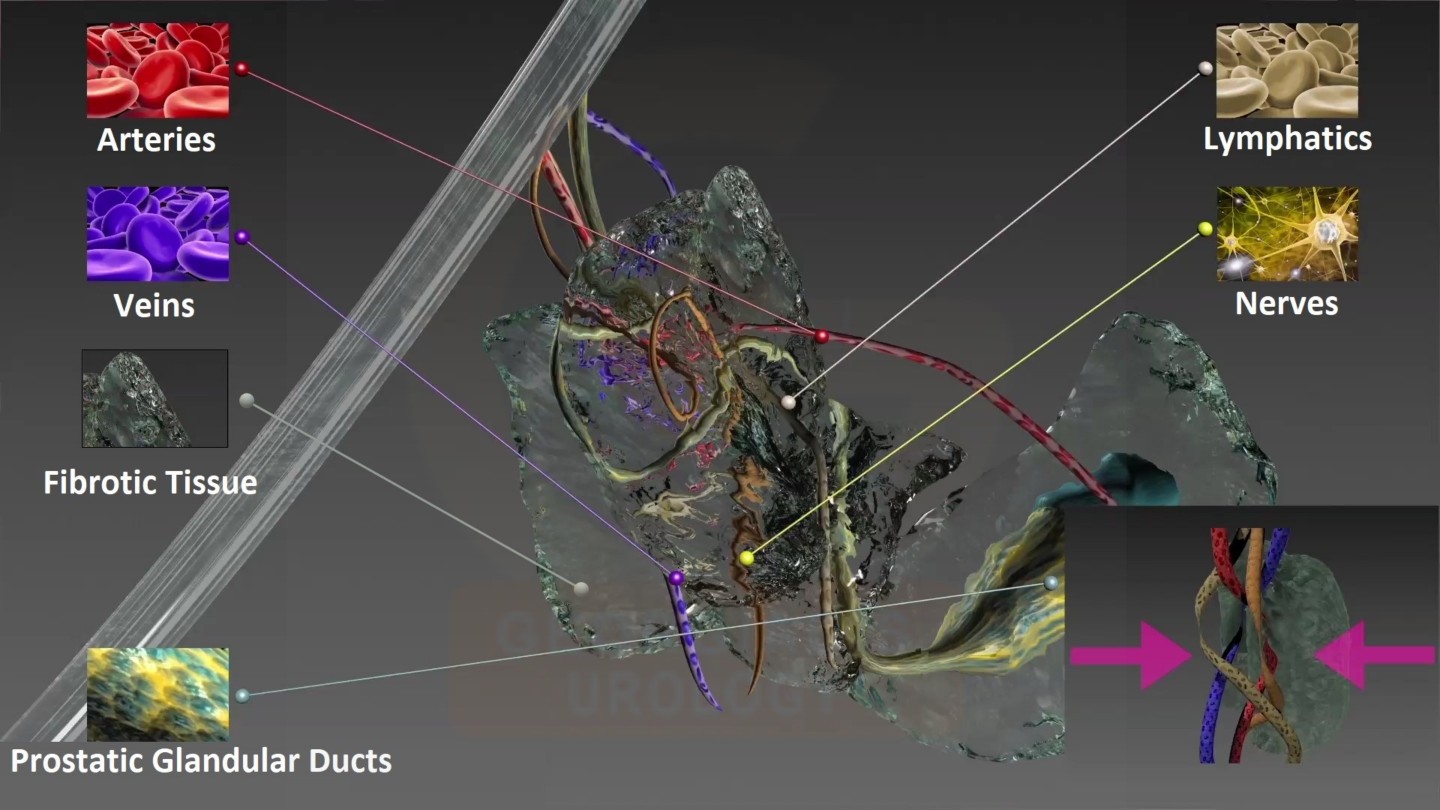
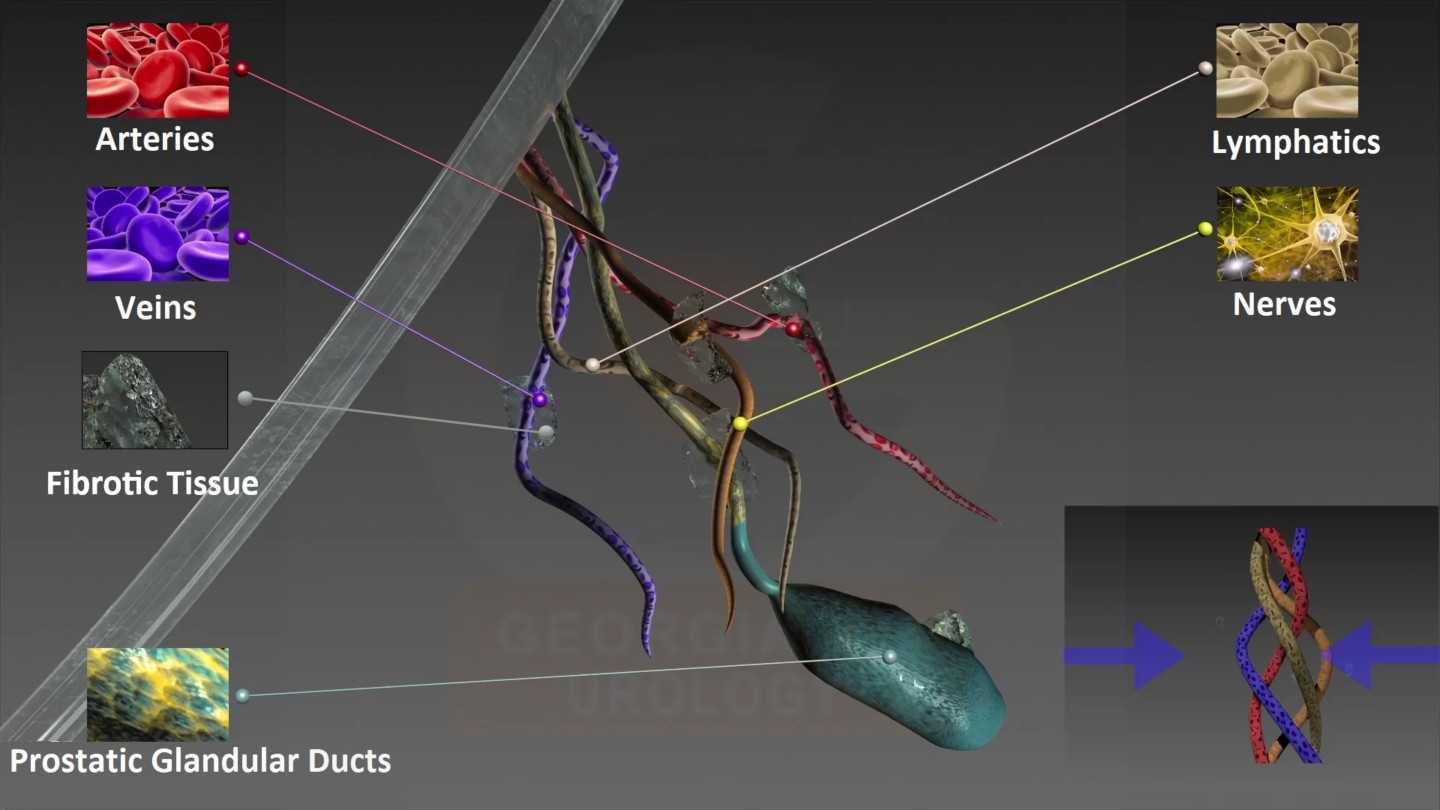
Schematic 3D illustrations produced for Georgiadis Urology. They show the mechanism, not a specific patient.
Why antibiotics alone fail
Four reasons a correct antibiotic can still lose.
Guideline treatment of chronic bacterial prostatitis is four to six weeks of an oral antibiotic chosen by culture. In an early, uncomplicated infection that can work. In an established chronic prostatitis it usually does not, for reasons that have been documented in the urological literature for decades and that we see confirmed on ultrasound every day.
1
The drug does not get in
Prostatic tissue is separated from the bloodstream by a lipid epithelial barrier and a pH gradient; most antibiotics reach only a fraction of their serum concentration inside the gland, and inflamed, poorly perfused tissue receives even less [1,2]. Oral courses deliver a dose the organisms can survive — and learn from.
2
The organisms are sealed in
Blocked ducts and microabscesses are closed compartments. Bacteria inside them live in biofilm attached to duct walls and debris, where they are shielded from both antibiotics and the immune system [3,4]. A drug that sterilises the urine and the open ducts leaves these reservoirs intact, which is why relapse follows every course.
3
Fibrosis strangles the supply lines
Chronic inflammation replaces elastic stroma with hard, fibrotic tissue that compresses the microcirculation. Less blood means less oxygen, fewer immune cells and lower drug concentrations exactly where they are needed. Sub-lethal exposure over repeated courses is how a sensitive organism becomes the multidrug-resistant one we culture at the first visit.
4
The oldest infection is the deepest
The first organisms settle around the urethra; later ones colonise the periphery. Cultures release what is nearest the surface, so a patient is usually treated for the newest organism while the original one stays hidden in the periurethral zone — fortified, resistant, and invisible until the ducts around it are opened.
This is why prostatic calcifications are so often misunderstood. Calcifications are calcium salts deposited into tissue that was already fibrotic and inflamed — a marker of how long the disease has been present, not its cause [5,6]. They are not inaccessible, and they do not make the disease incurable. The problem is the hardened, obstructed tissue around them; the calcification is a layer of paint on a wall that was already concrete.
Why cultures come back negative
You cannot culture what has not been released.
Around nine out of ten men with chronic prostatic symptoms are classified as “non-bacterial” (CP/CPPS, NIH type III) because their routine cultures are negative. In more than three decades we have yet to see a case that remained non-microbial after thorough investigation, and the reason is methodological rather than mysterious.
A routine sample is taken from urine or semen, sometimes after a brief, gentle prostatic massage. It samples the open ducts. It does not sample the blocked ones — which is where a chronic infection lives. Culture-independent sequencing studies have repeatedly found organisms in the prostatic secretions and urine of men labelled CP/CPPS [7,8]; the organisms are there, they are simply not being released or not being looked for hard enough.
We do three things differently. We perform targeted prostatic pressure on the regions ultrasound shows to be diseased before the sample is taken, so obstructed ducts actually contribute to it. We work with a microbiology laboratory that cultures expressed prostatic secretion and semen fully, including slow-growing and fastidious organisms, and adds PCR or next-generation sequencing where indicated. And we repeat cultures throughout treatment, because opening a new region of the gland routinely releases an organism nobody had seen.
What this looks like in our records
In the three documented cases on the protocol page, a second or third organism appeared only after the first had been cleared — Staphylococcus epidermidis resistant to 17 of 20 antibiotics surfacing at month three in one patient, Klebsiella, S. haemolyticus and Enterococcus faecalis emerging one after another over four years in another. These were not new infections. They were older infections reached for the first time.
It is also why a negative culture at the start of treatment is never, for us, the end of the investigation.
What each part of the protocol does
Open the gland. Then treat it.
Every pillar of the protocol exists to defeat one of the four failure mechanisms above. The order matters: the mechanical work comes first, because until the ducts drain and the microcirculation is restored, no antimicrobial — oral, intravenous or injected — reaches the organisms in a concentration that kills them.
Mechanism 1
Prostate pressure therapy
Restores access. Region-by-region manual compression of the gland under a map drawn from the ultrasound: which zones are hard, which ducts are distended, where the Doppler signal is strongest. Sustained, firm pressure breaks organised inflammatory foci, expresses pus and stagnant secretion from blocked ducts, softens fibrotic tissue and decompresses the vessels and nerves running through it. Work proceeds from the periphery inward, so the oldest, periurethral disease is reached last — and reached. This is not a prostate massage: the pressure applied is far more thorough and far more rigorous in intensity than any massage, it is aimed at specific regions rather than the whole gland, and it is repeated daily. It is the step that makes every other step possible.
Mechanism 2
Oral antibiotics
Systemic pressure, directed by culture. Chosen from the antibiogram of the patient’s own secretion and semen, and changed whenever the microbiology changes. Because the gland is being opened at the same time, tissue concentrations and organism exposure are higher than during any previous course the patient has had.
Mechanism 3
Intravenous antibiotics
Concentration where oral agents fall short. For organisms and resistance patterns where the oral route cannot reach adequate tissue levels, and to maximise antimicrobial exposure during the intensive phase — including in the days before an intraprostatic injection.
Mechanism 4
Intraprostatic injection
Bypasses the barrier altogether. Under transrectal ultrasound guidance, a culture-directed antimicrobial and anti-inflammatory combination is placed directly into the diseased regions of the gland. Local concentrations measured in the published series reach hundreds to thousands of micrograms per millilitre of prostatic fluid — levels no oral course approaches [9,10]. It is performed in a hospital, after written consent, and after the pressures have opened the tissue so the drug diffuses rather than pooling.
Why not just injections? Because an injection into a closed, fibrotic compartment stays where it is put. The pressures are what turn a sealed gland into one that drains and perfuses; the injection then delivers a concentration the organisms cannot survive. Used alone, injections relieve symptoms in many men but rarely clear the gland.
Why treatment comes in stages
The gland clears from the outside in.
Because infection spreads from the urethra outward and the pressures work from the periphery inward, the gland does not clear all at once. The peripheral zone responds first — usually within the first four to six weeks, which is when prostate volume falls fastest and most patients report their first clear symptom relief. The intermediate zones follow. The periurethral zone, where the original and most resistant organisms sit in the smallest, hardest, most obstructed ducts, is the last to open and the last to become sterile.
This sequence explains three things patients find confusing. It explains why a new organism can appear halfway through treatment: a duct that has just been opened releases what it held. It explains why symptoms sometimes lag behind the ultrasound: a gland that is ninety per cent healed can still have a nerve compressed by the remaining ten per cent, and that nerve keeps signalling until it is released. And it explains why four weeks is very rarely enough: the first block does the fastest, most visible work, and the return visit one to two months later does the work that prevents relapse.
Treatment ends when the cultures are negative and stay negative, leukocytes are at or below ten per field, and the ultrasound shows a settled gland with minimal Doppler signal — not when symptoms ease. Our records show that patients who keep their treatment blocks close together reach a substantially larger reduction in gland volume than those who leave gaps of a year or more.
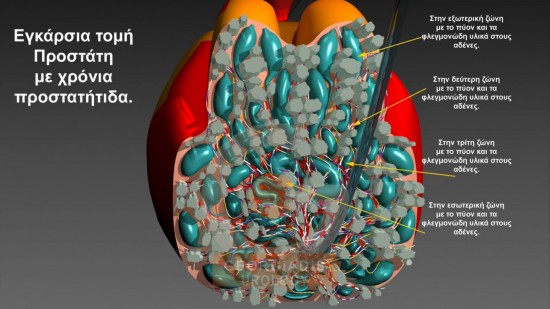
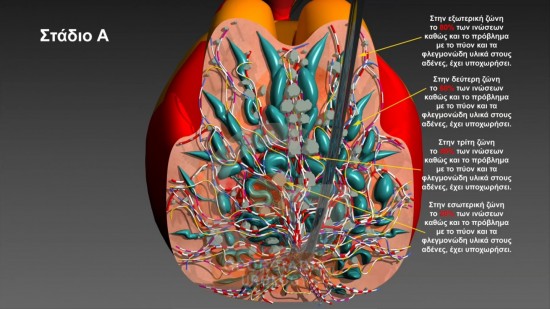
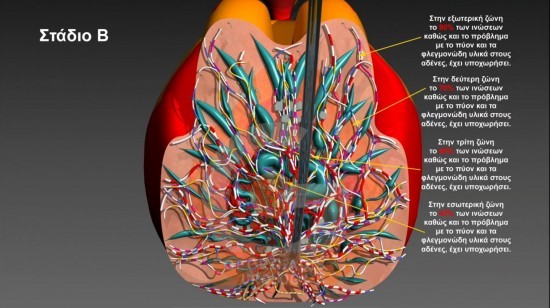
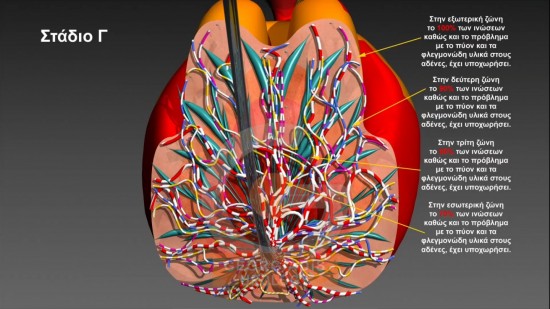
Schematic stages of clearance, periphery to urethra. Illustrations produced for Georgiadis Urology.
What determines how long it takes
Seven factors.
The amount of treatment a gland needs is set by the disease, not by the patient’s schedule. These are the variables we assess at diagnosis and reassess at every stage.
Chronicity
How long the organisms have been present — usually longer than the symptoms, and often years longer.
Tissue damage
The extent of fibrosis, strangulated vessels and nerves, obstructed ducts and calcification seen on ultrasound.
Gland size
Inflammatory enlargement means more tissue to open and more volume to reduce.
Complications
Periurethral fibrosis narrowing the urethra, seminal vesicle involvement, erectile tissue damage, fertility impairment — each needs its own attention.
Organisms and resistances
Every failed course has selected for resistance. Staphylococci, enterococci, Klebsiella and others acquire it readily; the isolates we clear are often resistant to half the antibiogram.
Continuity
Blocks of treatment kept close together compound; blocks separated by a year or more lose part of what was gained.
Lifestyle during treatment
No alcohol, no sugar, no spicy food, no prolonged hard sitting — through the rest periods as well. Patients who ignore this take longer.
Watch
The mechanism in five short animations
Produced by Georgiadis Urology to show how prostatitis starts, how fibrosis and urethral stricture form, where the burning and the other symptoms come from, and how the gland is cleared.
Questions about the mechanism
Straight answers
Is prostate pressure therapy the same as prostate massage?
No. A prostatic massage is a brief, gentle, general stroking of the gland, usually to obtain a sample. Prostate pressure therapy is sustained, firm, targeted compression of specific regions identified on ultrasound, repeated daily, with the explicit aim of breaking inflammatory foci, expressing obstructed ducts and softening fibrotic tissue. It is significantly more thorough and more rigorous in intensity than a massage, it is demanding for the physician, and it is the reason the rest of the protocol works.
Why did no other doctor find my organisms?
Most likely because the sample was taken from open ducts only, without prior targeted pressure on the diseased regions, or because the laboratory did not culture prostatic secretion and semen fully. Organisms sealed in obstructed ducts are not released into a routine sample. That is a limitation of the sampling, not evidence that the prostate is sterile.
Why has a new organism appeared in the middle of my treatment?
Because a region of the gland that was closed has just been opened. Infection is layered: the newest organisms sit at the periphery, the oldest around the urethra. As the pressures work inward, ducts that have been obstructed for years release what they held. It is a sign of progress, not of a new infection, and it is why we re-culture throughout treatment.
My ultrasound has improved but I still have symptoms. Why?
Symptoms are generated largely by nerves compressed within inflamed, fibrotic tissue. A gland that is largely healed can still have a nerve trapped by the remaining focus, and that focus is typically the deepest, periurethral one. Objective improvement precedes subjective improvement; the second stage of treatment exists to close that gap.
Do calcifications mean my prostatitis cannot be cured?
No. Calcifications are calcium deposits in tissue that was already chronically inflamed and fibrotic. They mark how long the disease has been present. The treatable problem is the hardened, obstructed tissue around them, and that responds to the protocol. Prostate volume, duct obstruction and Doppler signal all improve in glands with extensive calcification.
Can the injection replace the pressures?
For some patients who cannot tolerate or cannot attend daily pressures, injection-based treatment is a reasonable alternative that relieves symptoms in many. But an injection placed into closed, fibrotic tissue stays where it is put. Cure requires the ducts to drain and the microcirculation to recover, and only the mechanical work achieves that.
Where to go from here
The protocol and its results
The four pillars, the intensive weekly schedule, our audited 2020–2026 figures and three fully documented cases.
Symptoms and diagnosis
What chronic prostatitis feels like, including the subtle forms that go unrecognised for years, and how we investigate it.
Start with your history
Send us your previous cultures, imaging and treatments. We will tell you frankly whether we think we can help.
References
- Lipsky BA, Byren I, Hoey CT. Treatment of bacterial prostatitis. Clin Infect Dis. 2010;50(12):1641–1652.
- Charalabopoulos K, Karachalios G, Baltogiannis D, Charalabopoulos A, Giannakopoulos X, Sofikitis N. Penetration of antimicrobial agents into the prostate. Chemotherapy. 2003;49(6):269–279.
- Nickel JC, Costerton JW. Bacterial localization in antibiotic-refractory chronic bacterial prostatitis. Prostate. 1993;23(2):107–114.
- Nickel JC, Olson ME, Barabas A, Benediktsson H, Dasgupta MK, Costerton JW. Pathogenesis of chronic bacterial prostatitis in an animal model. Br J Urol. 1990;66(1):47–54.
- Geramoutsos I, Gyftopoulos K, Perimenis P, et al. Clinical correlation of prostatic lithiasis with chronic pelvic pain syndromes in young adults. Eur Urol. 2004;45(3):333–338.
- Shoskes DA, Lee CT, Murphy D, Kefer J, Wood HM. Incidence and significance of prostatic stones in men with chronic prostatitis/chronic pelvic pain syndrome. Urology. 2007;70(2):235–238.
- Nickel JC, Stephens A, Landis JR, et al. Search for microorganisms in men with urologic chronic pelvic pain syndrome: a culture-independent analysis in the MAPP Research Network. J Urol. 2015;194(1):127–135.
- Krieger JN, Riley DE. Bacteria in the chronic prostatitis–chronic pelvic pain syndrome: molecular approaches to critical research questions. J Urol. 2002;167(6):2574–2583.
- Plomp TA, Baert L, Maes RA. Treatment of recurrent chronic bacterial prostatitis by local injection of thiamphenicol into prostate. Urology. 1980;15(6):542–547.
- Jiménez-Cruz JF, Tormo FB, Gómez JG. Treatment of chronic prostatitis: intraprostatic antibiotic injections under echography control. J Urol. 1988;139(5):967–970.
- Kirby RS, Lowe D, Bultitude MI, Shuttleworth KE. Intra-prostatic urinary reflux: an aetiological factor in abacterial prostatitis. Br J Urol. 1982;54(6):729–731.
- European Association of Urology. EAU Guidelines on Urological Infections, 2026 edition, section on bacterial prostatitis. Arnhem: EAU Guidelines Office.
Medical disclaimer: this page describes the clinical reasoning behind the approach of Georgiadis Urology and is provided for information. It is not a substitute for individual medical advice. The mechanism described reflects our clinical experience and the literature cited; the protocol is not recommended as routine therapy by current European guidelines and is offered to appropriately selected, fully informed patients under the responsibility of the treating physician. Individual results vary and no outcome can be guaranteed.