Male Infertility – Signs & Symptoms
Conditions · Male infertility · Symptoms
Male infertility symptoms: the signs men overlook, and what each one says about the cause
The only symptom of male infertility that most men notice is the one that matters to them: no pregnancy. Everything else is quiet. Yet almost every infertile man has signs, in his semen, his testicles, the way he urinates or the way he has sex, that point straight at the cause, and nobody has asked him about them. This page lists those signs, group by group, and tells you which cause each one suggests and what should be tested.
The signs at a glance
The main sign: no pregnancy
Male infertility usually announces itself only as a couple’s failure to conceive after twelve months of regular, unprotected intercourse, or sooner if the woman is over 35 and the couple has been advised not to wait. Most men feel perfectly well. That is precisely why the male side is so often skipped: the woman is investigated first, treated for problems she may not have, and the man’s semen analysis, if it is done at all, is filed as “a bit low” without anyone asking why.
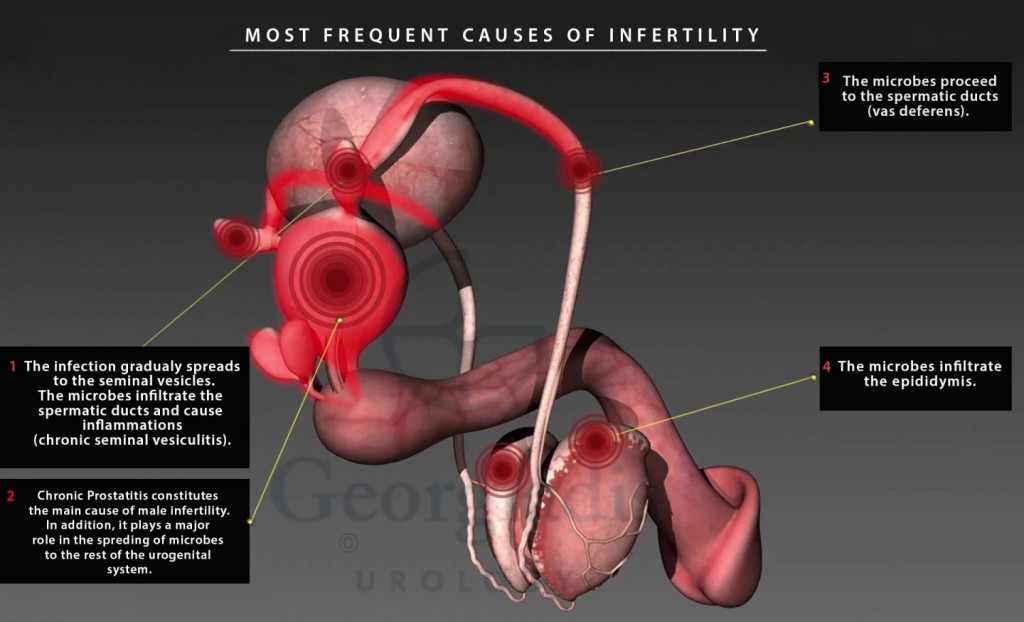
In our experience it is extremely rare not to find the cause of a man’s infertility, and the signs below are where the search starts. They are not symptoms of “infertility”; they are symptoms of the diseases that cause it, above all chronic prostatitis and its spread to the seminal vesicles and epididymis, and varicocele.
Signs in the semen
Men see their semen several times a week and rarely connect what they see with fertility. These changes are the earliest and most reliable signs of an inflamed prostate and seminal vesicles, the organs that produce almost all of the fluid.
Yellow, thick or clumpy semen
Healthy semen is greyish-white and liquefies within twenty to thirty minutes. Semen that is distinctly yellow, thick, lumpy or gelatinous, or that stays in clots for an hour, is full of white cells and inflammatory debris from the prostate and seminal vesicles. It is the single most common sign we hear once we ask.
Watery, thin or scanty semen
A very low volume, under about 1.5 ml, or semen that is thin and watery points to seminal vesicles that are not producing, blocked ejaculatory ducts, retrograde ejaculation into the bladder, or low testosterone. Volume that has clearly fallen over the years is a sign in itself.
Blood in the semen
Pink, brown or rusty semen (haematospermia) is inflammation of the seminal vesicles and prostate until proven otherwise. It is painless and frightening, usually settles on its own, and nearly always comes back, because the infection that caused it is still there.
A strong or foul smell, or burning after ejaculation
An unusual, fishy or foul smell, and stinging in the urethra or perineum after ejaculation, are signs of infection in the glands the semen passes through. So is a mild discharge from the urethra in the morning.
Signs in the testicles and scrotum
A soft swelling above the testicle, and heaviness
A varicocele is felt as a soft, lumpy, painless mass above the testicle, nearly always the left, that fills when you stand or strain and empties when you lie down, and in larger cases is visible as thick blue veins. The sensation is heaviness or a dragging ache after a day on your feet, after sport or lifting, or in hot weather. Many men have had it since their teens and consider it normal.
A testicle that is smaller or softer than the other
The left testicle hanging lower is normal; a left testicle that is clearly smaller and softer than the right is not. It means the sperm-producing tissue has been damaged, usually by a varicocele, sometimes by an old orchitis, an undescended testicle or low hormone drive, and it is the sign that most strongly predicts a poor semen analysis.
Pain, tenderness or thickening behind the testicle
The epididymis, the coiled tube behind each testicle, becomes thickened, firm and tender when it is chronically inflamed. Chronic epididymitis causes a dull ache that comes and goes for months, sometimes with a small firm lump at the top or bottom of the testicle, and it scars the duct through which sperm must pass. In the men we see the organisms come from the prostate.
A lump, or a testicle that has changed
Any hard lump in the testicle itself must be examined within days. Cysts of the epididymis (spermatoceles) are harmless in themselves but often sit beside a blocked duct. Pain patterns are explained in detail on our page on testicular pain.
Signs when you urinate
These are the symptoms of the condition that, in our experience, lies behind most male infertility: chronic inflammation of the prostate. Most men with an infertile semen have at least one of them and have never mentioned it to a doctor, because it seemed minor or unrelated.
- Burning or stinging when you urinate, or at the tip of the penis between urinations.
- Going more often, in small amounts, and feeling the bladder has not emptied.
- Getting up at night to urinate (nocturia), once or more, at an age when you should not.
- A weak, hesitant or split stream, dribbling at the end, or having to strain.
- An ache or pressure in the perineum (between scrotum and anus), low in the abdomen, in the groin, the testicles or the lower back, that comes and goes.
- Pain or discomfort during or after ejaculation, and a fullness in the rectum when sitting.
The full picture is on our page on the symptoms of chronic prostatitis. A man with any of these and a poor semen analysis needs his prostate examined, scanned and cultured before anything else is decided.
Signs during sex
Weaker or shorter-lived erections
Erectile dysfunction in a man under 50 is, more often than not, a sign of an inflamed prostate pressing on and irritating the nerves and vessels that run beside it, or of low testosterone. Either one also damages fertility. Erections that are not firm enough for intercourse are also, on their own, a mechanical cause of infertility.
Premature or painful ejaculation
Ejaculating within a minute of penetration, or pain during ejaculation and in the perineum afterwards, is typical of an inflamed prostate and seminal vesicles: the organs that contract to expel semen are sore. Delayed or absent ejaculation, or a “dry” orgasm, suggests retrograde ejaculation or nerve damage.
Less semen, less desire
A fall in the amount of semen over the years, and a falling sex drive, point to the seminal vesicles and to testosterone. Low libido with fatigue and loss of morning erections is the classic presentation of hypogonadism, which a blood test confirms.
Hormonal signs
Hormonal causes account for a small minority of male infertility, but their signs are visible: thinning of the beard and body hair, loss of muscle and strength, breast enlargement (gynaecomastia), small or very soft testicles, a small penis, persistent tiredness, low mood and a low sex drive. Men who have used anabolic steroids or testosterone for muscle gain have the same picture, because the testicles shut down when testosterone comes from outside. Headaches with loss of peripheral vision, or milky discharge from the nipples, suggest a pituitary cause and need prompt investigation.
Signs in your history
Some of the strongest pointers to a cause are not symptoms at all but events: an undescended testicle as a child, even if it was brought down surgically; mumps after puberty, with a swollen testicle; a hernia or hydrocele operation in childhood, which can damage the vas deferens; a sexually transmitted infection, treated or not, and any episode of urethral discharge; an episode of epididymitis or “orchitis”; chemotherapy or radiotherapy; a vasectomy and later reversal; regular use of saunas or hot baths, very tight clothing, or work in high heat; heavy smoking, alcohol or cannabis; and the medicines you take, from anabolic steroids and testosterone to some antidepressants, antihypertensives and anti-ulcer drugs. We ask about all of them; it helps to think about them before you come.
What to do with these signs
The diagnosis page explains each test and what it shows. When the signs on this page are taken seriously, the cause is found in nearly every man, and most causes can be treated.
Recognise yourself in any of these?
Bring your semen analysis and tell us about the signs you noticed, however minor they seemed. One visit covers the examination, the cultures and both ultrasounds, and gives you an answer about the cause.
Frequently asked questions
What are the first signs of infertility in a man?
Usually none beyond the failure to conceive. The earliest physical signs are in the semen, which turns yellow, thick, clumpy or scanty when the prostate and seminal vesicles are inflamed, and in the scrotum, where a varicocele causes heaviness and a soft swelling above the left testicle.
Can you tell if a man is infertile without a test?
No. A man can have a normal sex life, normal-looking semen and a normal body and still have a very low count. A semen analysis is the only way to know, and it must be repeated and followed by a search for the cause when it is abnormal.
Does yellow semen mean infertility?
Not by itself, but persistently yellow, thick or clumpy semen means inflammation of the prostate and seminal vesicles, which is one of the commonest causes of a poor semen analysis. It deserves a semen analysis with a white cell count and a culture.
Can burning urination be connected to infertility?
Yes. Burning, frequency and night urination in a young man are symptoms of chronic prostatitis, and chronic prostatitis is, in our experience, the commonest cause of male infertility. The two problems have the same cause and the same treatment.
Does erectile dysfunction mean low fertility?
Often they share a cause: an inflamed prostate or low testosterone lowers both erection quality and semen quality. Erections too weak for intercourse are also a direct cause of infertility. Both should be investigated together.
Is pain in the testicles a sign of infertility?
Chronic ache or heaviness in the testicles usually comes from a varicocele, chronic epididymitis or pain referred from the prostate, all of which damage fertility. A sudden severe pain is an emergency. Our testicular pain page goes through every pattern.